How To Change Text In Legend On Excel For Mac
You can also edit the text in the legend and change the order of the entries in the legend. This step applies to Word for Mac 2011 only: On the View menu, click Print Layout. Click the chart, and then click the Chart Layout tab.
- How To Change Text In Legend In Excel
- How To Change Text In Legend Qlikview
- How To Change Text In Legend In Excel Mac
In previous versions of Excel for Mac, when you inserted a chart into a spreadsheet, as in 2008, it gave the generic Series 1, Series 2, etc. I used to click on it, change the pointer to a cursor, and change it to 'Rainfall in Inches', or whatever the series represents. Now in 2008, it does NOT allow me to rename a series (I know I can do it with a column header, but that's not always feasible). The HELP menu is, as usual, useless.
What do you want to do? Edit legend entries on the worksheet • On the worksheet, click the cell that contains the name of the data series that appears as an entry in the chart legend. • Type the new name, and then press ENTER. The new name automatically appears in the legend on the chart. Edit legend entries in the Select Data Source dialog box • Click the chart that displays the legend entries that you want to edit. This displays the Chart Tools, adding the Design, Layout, and Format tabs.
Negating the helper table values can be troublesome, since I use the negative amount to format the vertical axis (positives display as integers, negatives display as currency). Thank you all so much for the blog. I have constructed a histogram in excel using the pivot table. I would like to add to the graph of the regular histogram, the cumulative frequency graph. Should I add to the pivot table a cumulative frequency column? On ablebits.com -how-to-create-a-histogram-using-the-pivottable. At the very end, you present the histogram for the frequency distribution with the cumulative frequency distribution added to the graph of the histogram but do not show the steps on how to add the cumulative frequency distribution to the graph using the same pivottable.
Its a bar chart where I am comparing to statistics so for each 'X' axis category there are two bars, but the series just say; series 1, series 2. I need to rename them to something that makes more sense, such as; Own behaviour, Others behaviour. As I am comparing behaviour between someone's own. Its a bar chart where I am comparing to statistics so for each 'X' axis category there are two bars, but the series just say; series 1, series 2. I need to rename them to something that makes more sense, such as; Own behaviour, Others behaviour.
• Click inside the Formula bar and enter the cell reference for the first series, Smith. In this case, that's =2011Commission!C19. • Adjust the size and format of the text box. Be sure to match the right series color when coloring the text box. • Repeat steps 1 through 4 for each series, making sure each legend matches its corresponding series color. There are many ways to simplify this technique.
I can FORMAT the legend, but not rename it. Any easy ways to do it? I guess it worked SO well, they just had to change it. BTW: Changing.xls to.xlsX means those poor suckers (a.k.a.
Microsoft has really made a big effort to simplify the process and place the customization options within easy reach. And further on in this tutorial, you will learn some quick ways to add and modify all essential elements of Excel charts. • • • • • • • • • • 3 ways to customize charts in Excel If you've had a chance to read our previous tutorial on, you already know that you can access the main chart features in three ways: • Select the chart and go to the Chart Tools tabs ( Design and Format) on the Excel ribbon. • Right-click the chart element you would like to customize, and choose the corresponding item from the context menu. • Use the chart customization buttons that appear in the top right corner of your Excel graph when you click on it.
How To Change Text In Legend In Excel
• You can only upload files of type PNG, JPG, or JPEG. • You can only upload files of type 3GP, 3GPP, MP4, MOV, AVI, MPG, MPEG, or RM. • You can only upload photos smaller than 5 MB. • You can only upload videos smaller than 600MB. • You can only upload a photo (png, jpg, jpeg) or a video (3gp, 3gpp, mp4, mov, avi, mpg, mpeg, rm).
Excel does an adequate job of creating a chart legend that identifies each series. If you find it rather bland, you can replace that default legend with one that identifies the series and important data. It's an easy way to make a point!
> > I hope this helps. If not, please let me know a little more about the data > you're trying to plot and I'll try to help.
A legend can make your chart easier to read because it positions the labels for the data series outside the plot area of the chart. You can change the position of the legend and customize its colors and fonts. You can also edit the text in the legend and change the order of the entries in the legend. • This step applies to Word 2016 for Mac only: On the View menu, click Print Layout.
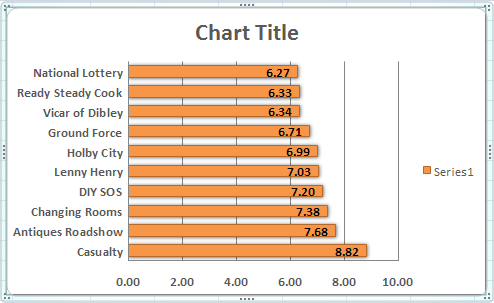
Showing or hiding the gridlines on the Excel chart In Excel 2013 and 2016, turning the gridlines on or off is a matter of seconds. Simply click the Chart Elements button and either check or uncheck the Gridlines box. Microsoft Excel determines the most appropriate gridlines type for your chart type automatically. For example, on a bar chart, major vertical gridlines will be added, whereas selecting the Gridlines option on a column chart will add major horizontal gridlines. To change the gridlines type, click the arrow next to Gridlines, and then choose the desired gridlines type from the list, or click More Options to open the pane with advanced Major Gridlines options. Hiding and editing data series in Excel graphs When a lot of data is plotted in your chart, you may want to temporary hide some data series so that you could focus only on the most relevant ones. To do this, click the Chart Filters button on the right of the graph, uncheck the data series and/or categories you want to hide, and click Apply.
Your suggestion led me to try another way of creating the chart that works: Insert Chart, select the label cell on the spreadsheet, select the data cell it corresponds to, repeat for each instance of label/data and then select the pie chart control from the elements gallery to create it. The concept I was missing is that the pie chart labels must be tied to a label on the spreadsheet. Thanks again.
Subscribe Now: Watch More: Editing the legend in Microsoft Excel is something you do by editing the cells in individual columns. Edit the legend in Microsoft Excel with help from a computer science and media production expert in this free video clip. Expert: Josiah Rea Filmmaker: Patrick Russell Series Description: Microsoft Office and programs like PowerPoint, Word and Excel are used both personally and professionally by millions of people all over the world on a daily basis.
How To Change Text In Legend Qlikview
Posted:, 07:56 PM On 6/25/08 3:13 PM, in article 9absDaxw, 'Dolphy@officeformac.com' wrote: > Version: 2008 > Operating System: Mac OS X 10.5 (Leopard) > > I have made some graphs in excell with five different lines of data. In the > legend, all it states is 'series 1, series 2' etc. I want to change the name > of 'series 1' to 'MW-1'. What do I do? One way is to select the chart, and then select the series. You will see the series formula in the formula bar. Replace the Series 1, etc.
Excel 2016 Word 2016 Outlook 2016 PowerPoint 2016 Excel 2013 Word 2013 Outlook 2013 PowerPoint 2013 Excel 2010 Word 2010 Outlook 2010 PowerPoint 2010 Excel 2007 Word 2007 Outlook 2007 PowerPoint 2007 When a chart has a legend displayed, you can modify the individual legend entries by editing the corresponding data on the worksheet. For additional editing options, or to modify legend entries without affecting the worksheet data, you can make changes to the legend entries in the Select Data Source dialog box.
To format the axis title, right-click it and select Format Axis Title from the context menu. The Format Axis Title pane will appear with lots of formatting options to choose from. You can also try different formatting options on the Format tab on the ribbon, as demonstrated in.
The horizntal axis is dates that I want to be able to select a minimum and maximum at will. For the graph on one tab when I right click on the horizontal axis I can see the 'Bounds' field with min and max listed under Axis Options so it is easy to change the min and max date fields. For the graph on the next tab, I cannot see the 'Bounds' listed under Axis Options. Gotta believe I am missing a simple setting somewhere. Thanks in advance for your help! I have a bar graph showing actual sales, with a line for the target. I am showing data for the entire year, even though we have only 4 months completed - the reason for this is to show the line as to where we are at to target.
As I am comparing behaviour between someone's own and other. The inspector only lets me rename the 'title' 'x axis' and the 'y axis'. Best Answer: I am assuming creating charts in Excel on a Mac is the same as on an IBM compatible. During the chart wizard stage, step 2, you have a tab Series, click on that and on the left side you will see the series listed in th series box,, i.e. Series 1, series 2 probably.
Then click outside the frame, so that the chart reappears in its normal place in the Word file. The legend should have changed.
Hope this sorts it out for you. • Tell us some more • Upload in Progress • Upload failed. Please upload a file larger than 100x100 pixels • We are experiencing some problems, please try again.
To edit a data series, click the Edit Series button to the right of the data series. The Edit Series button appears as soon as you hover the mouse on a certain data series.
You can also select two or more cells, e.g. A couple of column headings, and the content of all selected cells will appear in the chart title. Move the title within the chart If you want to move the title to a different place within the graph, select it and drag using the mouse: Remove the chart title If you don't want any title in your Excel graph, you can delete it in two ways: • On the Design tab, click Add Chart Element > Chart Title > None. • On the chart, right-click the chart title, and select Delete in the context menu. Change font and formatting of chart title To change the font of the chart title in Excel, right-click the title and choose Font in the context menu. The Font dialog window will pop up where you can choose different formatting options.
Click the 'Charts' tab on the ribbon, click 'Chart Layout,' click the 'Legend' button, and then click 'Legend Options' to load a list of customizable options for your legend. Click the 'Font' tab to customize the font. Click the 'Placement' tab to change where the legend appears on the chart.
• On the Layout tab, click Chart Title > Above Chart or Centered Overlay. Link the chart title to some cell on the worksheet For most Excel chart types, the newly created graph is inserted with the default Chart Title placeholder. To add your own chart title, you can either select the title box and type the text you want, or you can link the chart title to some cell on the worksheet, for example the table heading. In this case, the title of your Excel graph will be updated automatically every time you edit the linked cell. To link a chart title to a cell, perform the following steps: • Select the chart title. • On your Excel sheet, type an equal sign (=) in the formula bar, click on the cell that contains the needed text, and press Enter. In this example, we are linking the title of our Excel pie chart to the merged cell A1.
How To Change Text In Legend In Excel Mac
Click on one of the ‘sheets’. That should give you the accrual Excel data. In one of the ‘sheets’ (usually the first one), you should be able to see the labels for the legend in one of the columns. You simply over-write that in the target language and click on the ‘chart’ tab at the bottom.
You will see > the > series formula in the formula bar. Replace the Series 1, etc. With what > ever > you want to name the series. > > -- > Bob Greenblatt [MVP], Macintosh > bobgreenblattATmsnDOTcom > -- This posting is provided 'AS IS' with no warranties, and confers no rights. MS Mac Newsgroups: MS Mac News & Updates.
How to change data displayed on labels To change what is displayed on the data labels in your chart, click the Chart Elements button > Data Labels > More options This will bring up the Format Data Labels pane on the right of your worksheet. Switch to the Label Options tab, and select the option(s) you want under Label Contains: If you want to add your own text for some data point, click the label for that data point and then click it again so that only this label is selected. Select the label box with the existing text and type the replacement text: If you decide that too many data labels clutter your Excel graph, you can remove any or all of them by right-clicking the label(s) and selecting Delete from the context menu. Data label tips: • To change the position of a given data label, click it and drag to where you want using the mouse. • To change the labels' font and background color, select them, go to the Format tab on the ribbon, and choose the formatting options you want. Moving, formatting or hiding the chart legend When you create a chart in Excel, the default legend appears at the bottom of the chart in Excel 2013 and Excel 2016, and to the right of the chart in Excel 2010 and earlier versions.
I find that if I have one column (A) of labels and a second column (B) of labels and I select both and create a pie chart that way, it uses column A for the legend labels and column B for the data. I hope this helps. If not, please let me know a little more about the data you're trying to plot and I'll try to help. - June OfficeArt Tester, MacBU Microsoft On 3/28/08 11:23 AM, in article ee96462.1@webcrossing.caR9absDaxw, ' wrote: -- This posting is provided 'AS IS' with no warranties, and confers no rights. L.@officeformac.com 28/3/2008, 12:47 น. > Hi leu:) > > When you insert your pie chart, is it just with one column of data? I find > that if I have one column (A) of labels and a second column (B) of labels > and I select both and create a pie chart that way, it uses column A for the > legend labels and column B for the data.
I chose to use individual formulas to return each message component so you could easily follow the process. You can lump everything into one concatenating formula. You're free to position and format the text box legends in any way you like. Program to download on mac for pc downloads.
Create a chart defining upfront the series and axis labels Simply select your data range (in similar format as I specified) and create a simple bar chart. The labels should be defined automatically.
Let's consider the default graph shown below. It compares monthly commission earnings for four employees during 2011. The default legend identifies each employee. There are many ways to improve this chart, but we'll concentrate on enhancing the legend.
A blog about Me and Mark Publishing's products, game development, and Mac OS X development. Wednesday, January 31, 2007. Every copy of Mac OS X contains the Xcode Tools. If you have Mac OS X 10.4, there should be an item called Xcode Tools on the Mac OS X DVD. This item contains the installer. Xcode 10: Library Moved to Toolbar. September 17th, 2018. Filed under: Xcode| Be the first to comment! In Xcode 10 the Library, where you access things like code snippets and user interface elements, is no longer in the lower right portion of the project window. Me and mark publishing blog great job opportunity for mac.
If you prefer working with the ribbon, go to the Design tab and click Add Chart Element > Axes > More Axis Options Either way, the Format Axis pane will show up, you navigate to the Axis Options tab and select the Categories in reverse order option. Apart from flipping your Excel chart from left to right, you can also change the order of categories, values, or series in your graph, reverse the plotting order of values, rotate a pie chart to any angle, and more. The following tutorial provides the detailed steps on how to do all this:. This is how you customize charts in Excel. Of course, this article has only scratched the surface of Excel chart customization and formatting, and there is much more to it. In the next tutorial, we are going to make a chart based on data from several worksheets. And in the meanwhile, I encourage you to review the links at the end of this article to learn more.
However, you can customize the vertical axis scale to better meet your needs. Select the vertical axis in your chart, and click the Chart Elements button. Click the arrow next to Axis, and then click More options This will bring up the Format Axis pane. On the Format Axis pane, under Axis Options, click the value axis that you want to change and do one of the following: • To set the starting point or ending point for the vertical axis, enter the corresponding numbers in the Minimum or Maximum • To change the scale interval, type your numbers in the Major unit box or Minor unit box. • To reverse the order of the values, put a tick in the Values in reverse order box.
You may also be interested in: • • • • • •. Hi I am stumped. I have graphs in the same file on several different tabs.
Tip • Excel automatically inserts a legend with default formatting at your selected location in the chart. You can then format the legend's font and change its location via the Legend Options panel. To access the Legend Options panel, start by clicking your chart to select it.